


Explore the Matrix42 Marketplace
Enhance productivity and customize your digital workspace with ready-to-use apps and integrations.

Every finance team is building a number for AI spend into next year's budget right now. For most of them that number is a guess dressed up as a forecast, and the reason has nothing to do with how carefully it was put together. It is that the thing being forecast no longer behaves the way software spend used to.
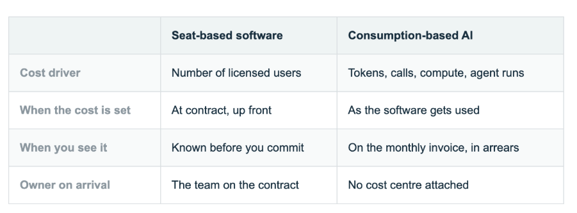
A software budget was once one of the easier lines to plan. You knew how many people needed a tool, you knew the price per seat, and the renewal twelve months later landed close to the figure you wrote down, because the cost moved with headcount and headcount moves slowly.
AI has broken that link, and the finance teams that treat it as just another software line are the ones most likely to be surprised when the invoice arrives.
The tools your teams reach for every day are no longer priced by the seat. They are priced by what gets consumed: tokens, API calls, compute time, the number of times an agent runs. The bill is set by usage, and usage does not sit still.
One engineer who leaves a batch job looping overnight, or an automated agent that starts calling a model in a retry loop, can run up more in a single night than an entire team's seat licences cost in a month. Nobody approved that spend in advance, because there was nothing to approve until it had already happened.
Forrester named this shift directly in its Q3 2026 landscape for software asset management, noting that AI-generated consumption is making software spend less predictable because pricing now depends on tokens, credits, API calls and agent activity rather than a fixed count of users. This is the fastest-growing part of the software bill, and it is the part finance has the least visibility into.
What makes it harder is that the shift happened quietly. No one stood up in a budget meeting and proposed moving the company's cost base from fixed to variable. It crept in one free API key and one team's experiment at a time, and the budget kept getting built on headcount logic while the actual cost had stopped following headcount at all.
The move from one model to the other changes everything you can plan with:
At the same time, we see growing relevance in the concept of software made in Europe. However, this relevance comes with clear expectations.
Sit a finance leader down in front of this year's AI spend and the awkwardness shows up fast, because the questions that matter most are the ones the current setup cannot answer.
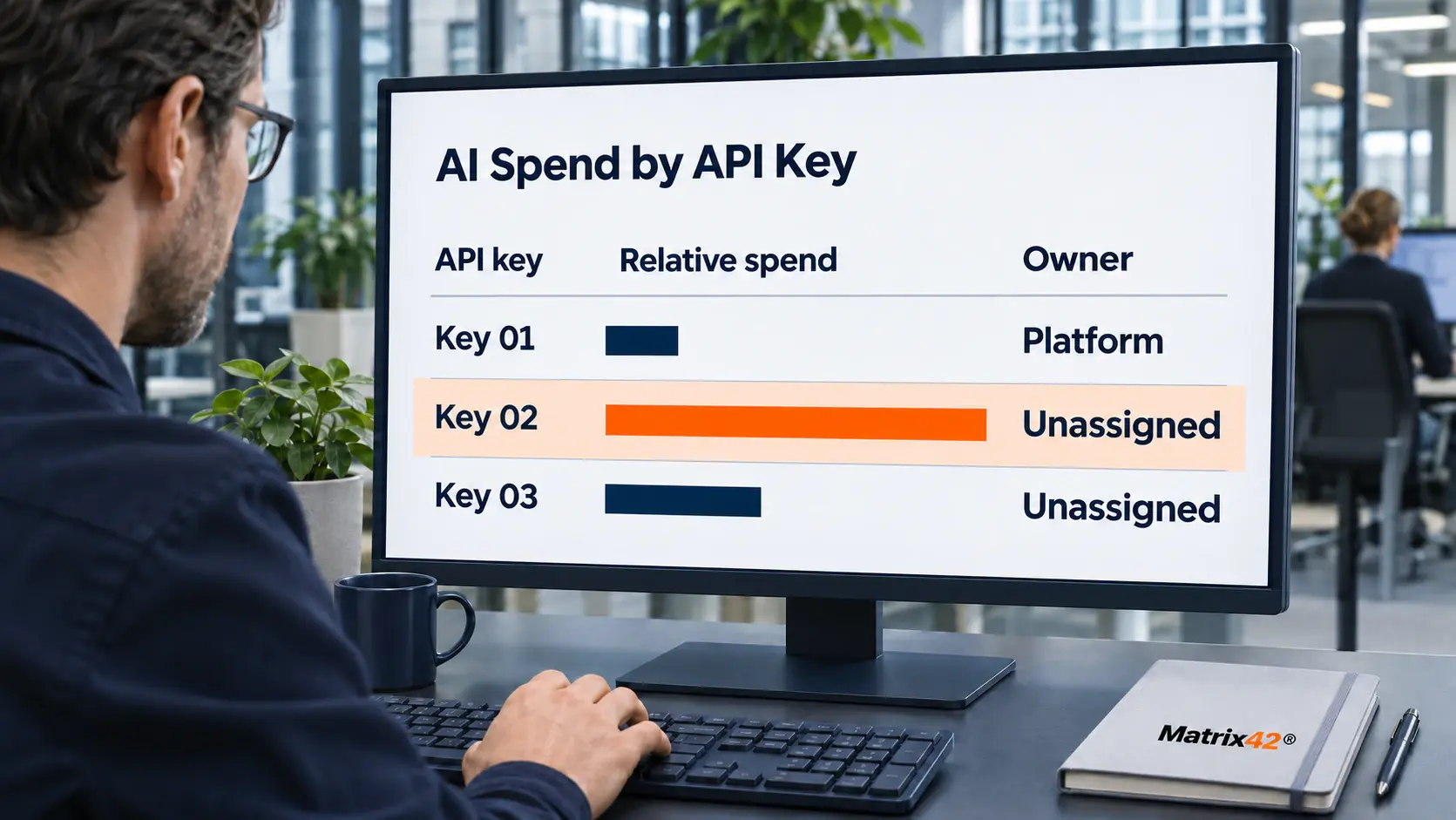
Ask what it will cost next month and the honest reply is that nobody knows until the invoice lands, because AI is metered by the token and billed in arrears. Ask who spent it and the trail goes cold, because usage is scattered across providers and personal API keys that arrived with no cost centre attached, so the spend shows up as a single lump sum from a provider rather than a cost tied to the team that caused it.
Ask whether it was worth it and the review stalls, because without one view of usage and spend, the meeting turns into an exercise in reconstructing the past month from memory instead of deciding where the next euro should go.
A forecast built on top of those three blanks is last year's invoice with a percentage bolted on for comfort, and everyone in the room knows it.
This stopped being hypothetical the moment the biggest vendors moved to metered pricing. From 1 December, usage-based billing is on by default for new Microsoft 365 Copilot Business licences bought through CSP, with a default allowance of 4,000 Copilot Credits per user each month.
At a cent per credit, that is up to $40 per user per month of spend that no entitlement report will show you, because the old reports were built to count seats, not consumption. Germany, France and the Netherlands get there a little later, which buys those markets a head start rather than an exemption.
The overruns are already landing, and they are landing on well-resourced teams. Uber reportedly worked through its entire 2026 AI coding budget by April, and in a DoiT survey of 500 finance and tech leaders, 79% reported AI-related cost overruns in the past year. In most of those cases the meter had been running for months before anyone thought to read it.
It would be easy to read all this as a case for clamping down on AI use, when the opposite is closer to the truth. AI spend is rising because the tools are earning their place, and the teams driving that spend are doing exactly what the business wants them to do. Capping their usage to control the cost would mean paying for the visibility problem with lost productivity, which is a bad trade.
The thing worth fixing is the blindness around the spend, not the spend itself. Every other significant cost in the business already has an owner, a running total someone watches, and a home in the reporting finance does every month. AI has none of that. It lives in separate provider accounts and expense claims, gets looked at once a month if at all, and belongs to no one in particular.
A CFO would never let a line this large sit this far outside the normal financial controls if it were labelled anything other than "AI," and the good news is that bringing it inside those controls takes nothing away from the teams using it.
Making the number predictable again is less about restraint and more about visibility and ownership, and it comes down to treating AI spend the way you already treat everything else on the books.
That starts with seeing the spend as it happens rather than a month later. When cost and usage are visible in real time across every connected provider, with a daily running average, a sudden spike becomes something finance notices and questions the day it occurs, not a mystery that surfaces four weeks on when the invoice forces the conversation. The runaway agent stops being a line item you explain after the fact and becomes one you catch in the act.
From there, every euro gets an owner. Spend maps onto the structure the business already reports on, so an AI cost lands against a country, a cost centre, a division or a department instead of floating free, and anyone can trace a number down to the provider, the model and the person behind it.
The next cost conversation happens with the team that drove the spend, and it opens from a figure both sides can see rather than an accusation and a denial.
The last piece is managing AI next to the rest of the software estate instead of in a dashboard of its own. AI is simply the newest line on the software bill, and it belongs in the same view as the SaaS applications, subscriptions and contracts finance already tracks.
This matters more than it sounds, because organizations are typically aware of only 40% of the applications in use across the business, and the AI providers slipping in on personal keys now hide inside that same gap.
Organizations are typically aware of only 40% of the applications in use; the rest runs unseen by IT and finance
This is what Matrix42 SaaS Management is built to do: pull AI consumption and the wider SaaS estate into one view, so finance stops reconstructing the picture from provider portals and spreadsheets.
On the SaaS side of that estate, where licences are easier to rationalise than live AI consumption, Matrix42 customers have cut software licensing costs by up to 20% once the waste becomes visible. Metacore brought its scattered SaaS into one view and reduced spend doing exactly that.
It would be easy to read all this as a case for clamping down on AI use, when the opposite is closer to the truth. AI spend is rising because the tools are earning their place, and the teams driving that spend are doing exactly what the business wants them to do. Capping their usage to control the cost would mean paying for the visibility problem with lost productivity, which is a bad trade.
A software budget became hard to predict the moment its cost stopped following headcount and started following usage, and that change is not going to reverse. The finance teams that keep treating AI as an exception to normal financial discipline will keep meeting the same surprise on the invoice, quarter after quarter, and keep defending a budget line they cannot fully explain.
The ones who plan well will be the ones who gave AI spend what every other cost on their books already has: a live number someone owns, mapped to the structure they report on, inside the estate they already manage.
Do that, and next year's AI budget stops being a figure you brace yourself to defend. It becomes one you can trace to the team behind it, question when it moves, and stand behind when the board asks whether it earned its keep.
If you want to see your own AI spend broken down by cost centre before the next invoice lands, book a demo and we'll walk through it against your estate.
Sources: Forrester, The SaaS and Software Asset Management Solutions Landscape, Q3 2026. Gartner, Magic Quadrant for SaaS Management Platforms, June 2026. Microsoft 365 Copilot usage-based billing documentation (Microsoft Learn). DoiT, The AI Spend Reality Check: Survey of 500 Finance & Tech Leaders. Uber AI coding budget figure as reported in trade press.